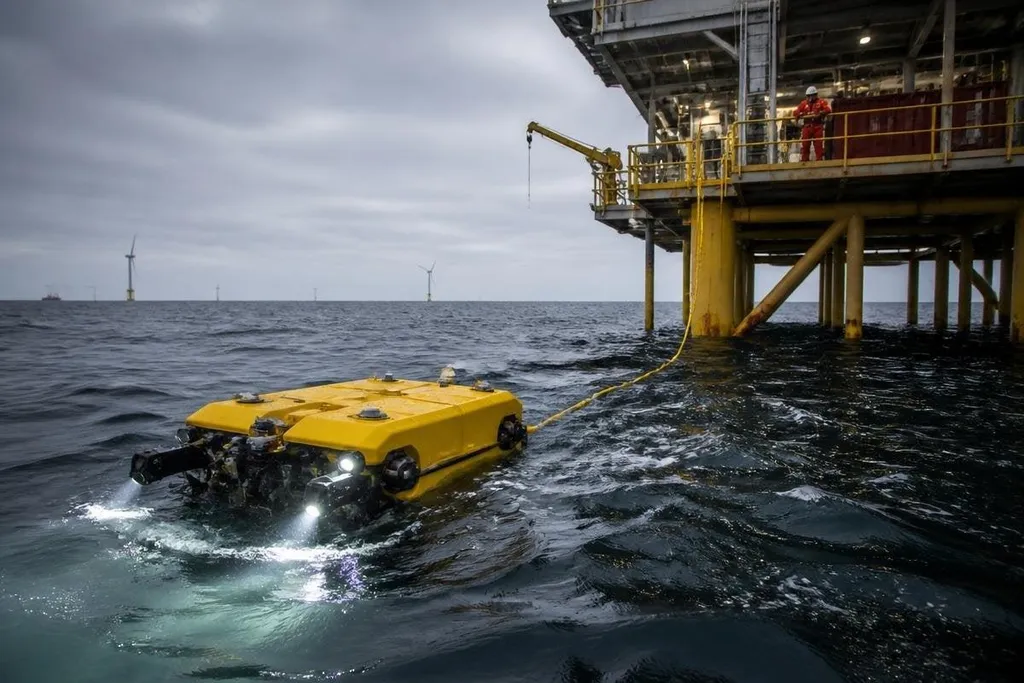
An offshore robot may spend hours in dark water, salt spray, high winds, or poor visibility. Its value comes from doing useful work in those conditions while reducing the number of people sent into them.
Quick read
- Subsea robots inspect structures, cables, pipelines, and seabeds without putting divers in the water.
- Surface drones and aerial systems can check large sites, but weather and communication links limit them.
- The next test is repeatable maintenance, not another short demonstration.
Where the work starts
Offshore energy sites contain many jobs that are dull, costly, or unsafe for people to repeat. A robot can inspect a wind turbine blade, check a subsea cable route, or collect images around a platform while a crew stays on the support vessel or onshore.
The robot still needs a clear job. “Inspect the asset” is too broad. A useful task might be finding corrosion on a steel joint, measuring damage on a blade, or checking whether a cable has moved from its planned route.
That detail changes the system design. A remotely operated vehicle, or ROV, uses a tether for power, control, and data. An autonomous underwater vehicle, or AUV, carries its own battery and follows a mission plan, so it can cover an area without a continuous cable connection.
The machines have different limits
ROVs suit close inspection and work that needs a manipulator, the robot arm used to touch or move an object. An operator can guide the arm around a valve or structure while cameras, lights, sonar, and force sensors show what the robot is doing.
AUVs suit mapping and repeated survey work. They can carry sonar and cameras through water, then return with data for review. They aren't the right choice for every repair because they may lack the arm, power, or communication link needed for physical work.
Above the water, drones can inspect blades, towers, roofs, and flare stacks. Wind, rain, glare, and restricted flight areas can stop a flight before the robot reaches the asset. An image also needs a clear link to a maintenance decision. A large folder of pictures is not a repair plan.
Data has to reach the work order
The useful output is rarely the robot’s movement. It is a record that tells a technician what changed, where it changed, and what action comes next. That record may include images, sonar maps, location data, and a comparison with an earlier inspection.
This is where robotics meets software used by maintenance teams. A robot that finds a defect but cannot place it on the correct asset record creates more office work. A system that marks the location, keeps the original data, and sends a clear task to the crew has a better chance of being used again.
The software record matters only when the field test behind it is clear. Offshore robotics reports from Robot24.com can place the vehicle, task, sensor setup, and test site beside a claim about autonomous inspection. That record lets you compare a field result with a staged demonstration.
The hard part is repeatability. Salt water affects connectors and housings. Currents change the vehicle’s path. A manipulator can lose contact with a surface when the support vessel moves.
Any plan for offshore robotics has to account for those physical problems before it counts labor savings.
What remains unproven
Inspection is easier to show than maintenance. A camera can record a surface, but a repair robot has to reach the defect, hold position, apply the right force, and leave the asset safe to operate.
Communication also sets a boundary. Underwater radio links work differently from links in air, and water can block or weaken signals. An AUV may need to store data and return later, while an ROV depends on its tether and surface equipment.
I’d judge an offshore robot by the work it removes from a maintenance plan, not by how smoothly it moves in a video.
A practical buying check
Use these questions before funding a pilot:
- Name the task: Can the team state the defect, measurement, or repair the robot must handle?
- Set the handoff: Where will the inspection data go, and who will approve the next action?
- Check the conditions: Does the system work in the site’s depth, current, wind, temperature, and visibility range?
- Plan failure recovery: Can the crew retrieve, recharge, repair, or manually control the robot after a fault?
- Count the human work: Which trips, dives, or hours disappear, and which tasks remain?
The next useful proof will come from repeated offshore jobs with clear records of failures, repairs, crew time, and asset condition. Until those records are public, the open question is how much routine maintenance these robots can remove from a real energy site.